The science behind infrared therapy — how it really works

The science behind infrared therapy — how it really works
Infrared is everywhere. But what does the science actually say? In this article we dive into the three types of radiation, the clinical research and the six health benefits backed by data.
Infrared therapy is not a wellness trend without foundation — it is a form of heat transfer with measurable effects on the human body. In this article: what infrared is exactly, the three types of radiation (FIR, MIR and NIR), how your body responds physiologically to infrared heat, and the six scientifically supported health benefits. With references to peer-reviewed studies.
What exactly is infrared therapy?
Infrared therapy uses electromagnetic radiation with a specific wavelength (between 0.75 and 1000 micrometres) to heat the body deeply and directly — without the surrounding air having to become extremely hot. That makes it significantly more comfortable and more effective than traditional heat sources such as a steam sauna or a hot bath.
When infrared rays hit your skin, they penetrate your tissues and generate heat there. It's the same way the sun warms us — without harmful UV radiation. In fact, your own body gives off infrared radiation, with peak emission around 9.4 micrometres.
There are three types of infrared radiation, each with its own wavelength and its own effect on the body.

The three types of infrared radiation: FIR for deep relaxation, MIR for circulation, NIR for cell regeneration.
Far infrared (FIR) — 15 to 1000 micrometres
FIR is the most widely used form in sauna blankets and infrared cabins. This radiation penetrates 2 to 5 centimetres deep into muscles, joints and tissues — deeper than any other heat source. FIR has been shown to be effective for chronic pain, fibromyalgia, rheumatic conditions and recovery after exertion. The Flamengo infrared sauna blanket works on this FIR frequency.
Middle infrared (MIR) — 3 to 15 micrometres
MIR works at a somewhat more superficial level than FIR and is particularly effective for improving blood circulation and relieving joint pain. MIR is often used in combination with FIR, for example in the InfraStretch mat.
Near infrared (NIR) — 0.75 to 3 micrometres
NIR works at cellular level and stimulates mitochondrial activity — the "power plants" in your cells. This speeds up cell regeneration. NIR is widely used for skin improvement, wound healing and anti-ageing applications.
How your body responds to infrared heat
When FIR radiation reaches your skin, several physiological processes happen at the same time. This isn't mysticism — it's measurable biology.

Why infrared penetrates deep into tissues, while traditional heat stays at the skin's surface.
Step by step, the following happens in your body:
- Penetration: FIR penetrates 2 to 5 cm deep into muscles and tissues, beyond the skin layers where surface heat stays.
- Vasodilation: blood vessels widen, increasing blood flow by up to 4 times in the heated areas.
- Cellular activation: molecular vibrations in water and protein molecules increase, stimulating metabolism at cellular level.
- Thermoregulation: your body responds by sweating — a natural process that removes waste products through the skin.
- Endorphin release: the hypothalamus releases endorphins, which dampen the natural sensation of pain.
- Cortisol drop: the stress hormone cortisol falls, while the parasympathetic "rest and recover" mode is activated.
This cascade of effects has been confirmed by various clinical studies. A review in Canadian Family Physician from 2009 concluded that infrared therapy is safe and has demonstrable benefits for cardiovascular disease, chronic pain and recovery processes.
The six scientifically supported benefits
Research into infrared therapy grows every year. Below are the six most researched and consistently confirmed benefits — with the evidence level as assessed in peer-reviewed reviews.

The six most researched and confirmed benefits of infrared therapy.
FIR penetrates into muscles and joints, which has a direct pain-relieving effect for chronic complaints such as fibromyalgia, rheumatoid arthritis and muscle tension. A Japanese study showed pain reduction of 31 to 77% with regular use.
Regular use of infrared therapy has been linked in research to a measurable drop in both systolic and diastolic blood pressure. Japan's Finnish-style Waon therapy (60°C infrared, daily) is even used as support for chronic heart failure.
Infrared-induced sweating supports the natural detoxification process. Research shows that infrared sweat contains a higher concentration of heavy metals and other waste products than sweat from traditional exertion. The body detoxifies itself — infrared supports that process.
An infrared session activates the parasympathetic nervous system — the "rest and recover" mode. Cortisol falls, endorphins rise. Studies confirm that regular use leads to deeper, more effective sleep, especially when a session takes place shortly before bedtime.
NIR and FIR both stimulate the production of collagen and elastin in the skin. This supports skin renewal, reduces fine lines and helps with wound healing. Many dermatologists use infrared therapy as a complement to cosmetic treatments.
FIR speeds up the removal of lactic acid and other waste products after intensive training. Many elite athletes integrate infrared therapy into their recovery protocol. Also read our article on boosting muscle recovery with infrared.
Why a sauna blanket vs a traditional sauna?
Traditional Finnish saunas heat the air to 70-90°C. You sit in hot air and sweat because of the air temperature. An infrared sauna blanket works in a fundamentally different way: FIR rays heat the body directly, not the surrounding air.
| Aspect | Infrared sauna blanket | Traditional sauna |
|---|---|---|
| Heating | The body directly via FIR | Surrounding air 70-90°C |
| Penetration | 2-5 cm into muscles | Superficial (skin) |
| Temperature | 50-65°C, comfortable | 70-90°C, hard on the heart |
| Energy consumption | Low (650W) | High (4500W+) |
| Accessibility | At home, from €449 | Fixed location, €2000+ |
| Scientific effect | Deeper tissue effects | Strong cardiovascular |
Both forms have their benefits, but for deep muscle relaxation and chronic pain relief FIR heat has a clear physiological advantage: it reaches tissues that traditional heat does not.
The Flamengo toolkit — science applied
Our tools are designed on the basis of the science we describe here. Three products, three scientific approaches:
| Product | Scientific action | Best for |
|---|---|---|
| Sauna blanket | FIR 50-65°C, 360° body | Whole body, relaxation, recovery |
| InfraStretch | FIR + vibration + pressure points | Back, neck, shoulders (upper body) |
| InfraPulse | Targeted FIR + vibration massage | Specific joints and pain points |
What they have in common: they all rely on the scientifically proven power of FIR radiation. What sets them apart: the part of the body they focus on.
What should you look out for?
Infrared therapy is safe for most people — significantly safer than a traditional sauna because of the lower ambient temperature. But there are some points to bear in mind.
- are pregnant;
- have heart problems, arrhythmias or a pacemaker;
- take medication that affects your heat response or blood pressure;
- have recently had surgery;
- have diabetes or reduced heat sensation;
- have cancer (consult your specialist first);
- have high blood pressure;
- have symptoms of dehydration or kidney disease.
Frequently asked questions about the science of infrared
Yes, for several applications there is strong scientific evidence. In particular the cardiovascular effect (lower blood pressure), pain relief for chronic conditions, improved sleep and faster muscle recovery have been confirmed in peer-reviewed studies. For some applications (such as detox) the evidence is still more limited.
FIR (far infrared) has the longest wavelength (15-1000 µm) and penetrates deepest — up to 2-5 cm into muscles. MIR (middle infrared, 3-15 µm) works at a more superficial level and is good for circulation. NIR (near infrared, 0.75-3 µm) works at cellular level and is ideal for skin renewal.
No. Infrared radiation is non-ionising and fundamentally different from the sun's UV radiation. The ICNIRP (the international authority on radiation) confirms that FIR radiation poses no health risk with normal use. It is the same wavelength your body gives off itself.
Far infrared penetrates 2 to 5 centimetres deep into muscles, joints and tissues. That is significantly deeper than surface heat sources such as heat patches or warm baths (which barely get past the skin). That's why FIR has a fundamentally different effect on the body.
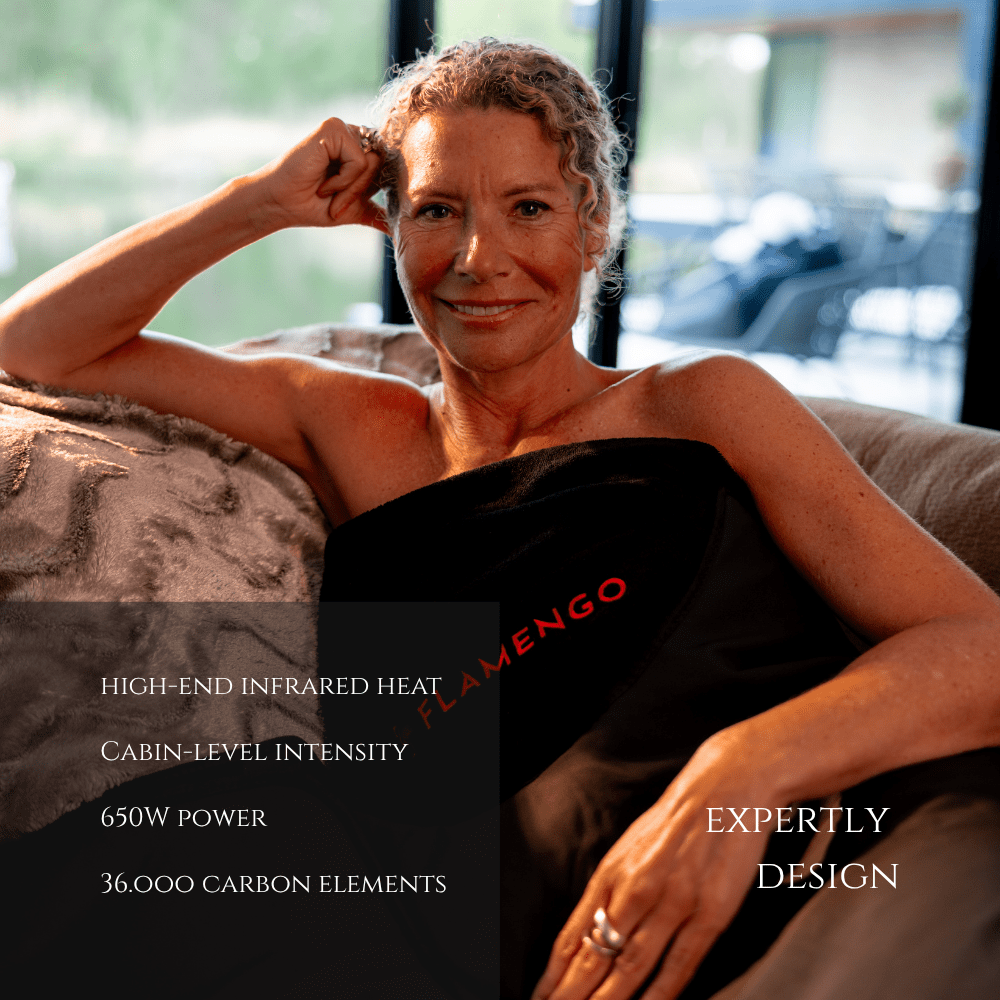
Most sauna blankets, including Flamengo's, work with FIR (far infrared). Scientifically, this is the most effective form for deep relaxation, pain relief and recovery. The Flamengo sauna blanket has 36,000 carbon-fibre elements that produce even FIR heat.
For noticeable effects: at least 3 sessions a week for 4 to 8 weeks. Scientific studies usually use 2 to 5 sessions a week. Consistency matters more than intensity — a fixed ritual works better than an occasional long session.
Yes, a 30-minute session burns roughly 150 to 300 kcal through the raised heart rate and metabolism while sweating. It's no substitute for exercise, but it is extra support for a healthy lifestyle.
Yes, this is one of the best-supported effects. During a session the parasympathetic nervous system is activated, cortisol falls and endorphins rise. Many people experience immediate relaxation, and with regular use the effect becomes cumulative.
Conclusion
Infrared therapy is not a wellness trend without foundation — it is a form of heat transfer with demonstrable effects on the human body, supported by dozens of clinical studies. FIR radiation (far infrared) in particular has strong evidence for pain relief, cardiovascular effects, improved sleep and faster muscle recovery. At Flamengo, we designed our tools on the basis of this science. The sauna blanket, InfraStretch and InfraPulse each target a different area of the body, but all work from the same scientific foundation. Start gently, build up gradually and experience the effect for yourself.
Sources: Canadian Family Physician — Clinical applications of infrared therapy, PubMed — Waon therapy clinical studies, ICNIRP — Infrared radiation safety. This article is for information only and does not replace medical advice.