Stiff muscles: 6 causes & ways to loosen up again

Stiff muscles: 6 causes and how to get your body supple again
Stiff muscles — when getting up, after sitting for a long time or for days on end — are a common complaint that only increases with age. But age is far from the only cause. What is going on, and what really helps to make your muscles supple again?
Everyone gets stiff muscles — sometimes temporarily after intense exercise, sometimes structurally due to age, lifestyle or an underlying cause. The feeling: muscles that no longer move along the way they used to, especially in the morning when getting up or after sitting for a long time. Stiffness is not a disease in itself, but a signal — the question is what that signal is trying to tell you. In this article: the six main causes of stiff muscles, how to recognise them and six ways to get your body supple again — with heat therapy as one of the most direct solutions.
What exactly are stiff muscles?
Muscle stiffness is a combination of several processes: shortened muscle fibres, stiffened connective tissue (fascia), reduced circulation and raised baseline tension in the nervous system. The feeling often comes from a combination of these factors, not one single cause.
Important difference: stiffness is not the same as muscle soreness. Muscle soreness is caused by damaged muscle fibres after exertion — usually within 24-48 hours and gone again after 3-5 days. Stiffness is more chronic: your muscles feel tight, shorter and less elastic. Sometimes they occur together, but they have different causes and approaches.
There is also a difference between "stiff muscles and joints" — which often go together. Stiff muscles around a joint can put extra strain on the joint, and conversely a stiff joint can cause surrounding muscles to tense up in a protective reflex. This explains why people with osteoarthritis or rheumatism also often experience joint pain.
The 6 main causes of stiff muscles
What is going on for you? The six most common causes, often in combination:

The six most common causes — often several are at play at once.
1. Ageing — reduced collagen production
From around the age of 40 the body produces less collagen — the building block of connective tissue and muscle fascia. The result: less elasticity, slower recovery and stiffer muscles when getting up. This process is normal, but its extent varies greatly from person to person. Stiff muscles due to ageing does not mean "you just have to accept it" — a targeted approach can make a big difference.
2. Too little exercise — office work and a sedentary life
The most dangerous cause in the Netherlands: long periods of sitting. Muscles that don't move for hours gradually shorten, especially the hip flexors, hamstrings and lower back. The fascia become "sticky" and lose their ability to glide. Result: stiffness that gets worse as the hours pass.
3. Menopausal symptoms in women
Stiff muscles during menopause are common. The hormone oestrogen affects connective tissue, cartilage and pain perception. As oestrogen falls around the age of 45-55, many women experience structural stiffness and muscle pain for the first time — especially in the morning and after inactivity. More on this in a separate section.
4. Dehydration and magnesium deficiency
Muscle fascia consist largely of water. With chronic mild dehydration (quite common in the Netherlands) they become stiffer. Magnesium also plays a role: a deficiency causes muscle cramps and stiffness. Especially noticeable at night or early in the morning.
5. Vitamin D deficiency
In the Netherlands an estimated 40-50% of adults have a vitamin D deficiency, especially in winter and spring. Symptoms: stiff muscles, muscle weakness and general fatigue. A simple blood test at your GP gives clarity. If you are deficient, supplementation is cheap and effective.
6. Chronic stress
Stress raises cortisol and sympathetic nervous activity — both cause continuous mild muscle tension. Especially in the neck, shoulders and back. With prolonged stress the baseline tension is no longer "reset" and muscles stay chronically tense. You often see this in people with demanding jobs or chronic worries.
Stiff muscles in older age
Stiff muscles and ageing is a frequently heard combination — but what is happening biologically and what can you do?
From the age of 40 we lose about 1% of muscle mass per year if we do nothing (sarcopenia). The remaining muscles become less elastic due to:
- Reduced collagen production — less supple connective tissue;
- Slower circulation — nutrients and waste products are transported more slowly;
- Reduced mitochondrial function — less energy in the muscle cells;
- More "cross-links" in connective tissue — adhesions that restrict suppleness.
What specifically helps with age-related stiffness?
- Strength training: 2-3x a week, helps preserve muscle mass and reduce stiffness;
- Protein intake: 1.2-1.5 g per kg of body weight — more than used to be recommended;
- Heat therapy: stimulates circulation and loosens fascia, very effective for age-related stiffness;
- Vitamin D + magnesium: important muscle nutrients that are often lacking;
- Daily exercise: even in less pleasant weather — walking, cycling, swimming.
Stiff muscles during menopause
For many women around 45-55 this is a familiar complaint: suddenly muscles feel stiffer when getting up in the morning than they used to. Sometimes it moves around — the neck today, the hip tomorrow. The link with menopause is often made late, but it is real.
What happens hormonally?
Oestrogen has an anti-inflammatory and tissue-protecting effect. As oestrogen falls:
- Systemic inflammation rises subtly;
- Pain perception changes — the pain threshold drops;
- Connective tissue becomes less elastic;
- Sleep quality drops — poor sleep makes muscles stiffer.
What specifically helps with menopausal stiffness?
In addition to the general approach, these specific measures work for many women during menopause:
- Heat therapy 3-4x a week: supports circulation and helps sleep — two weak links during menopause;
- Strength training: important for maintaining muscle now that muscle mass declines faster;
- Protein + magnesium + vitamin D: three crucial building blocks for muscles;
- With severe symptoms: discuss hormone therapy with your GP or a menopause consultant.
Stiffness when getting up and in the legs
Two specific patterns that are common: stiff muscles when getting up and stiff muscles in the legs.
Stiffness when getting up — what's going on?
At night your body moves relatively little. Joint fluid is pumped around less, circulation slows and body temperature drops. Result: in the morning fascia and muscles are less supple. For most people this passes within 10-15 minutes. Does it last longer than 30 minutes? Then it may point to osteoarthritis, or, combined with other symptoms, to rheumatism.
What helps straight away in the morning:
- 5 minutes of gentle stretching exercises in bed before you get up;
- A warm shower — not too long, not too hot;
- Drink warm water with lemon — hydration + mild anti-inflammatory effect;
- For a structural approach: a session in an infrared sauna blanket in the evening before bed — many people notice less morning stiffness the next day.
Stiff muscles in the legs
A common pattern: stiffness in the calves, hamstrings or thighs. Causes are usually: prolonged sitting, too little stretching, mineral deficiency (magnesium, potassium) or early circulation problems. In older people it can also point to claudication (vascular problems) — if the symptoms only occur while walking and disappear at rest, a visit to your GP is sensible.
For ordinary lifestyle-related stiffness in the legs this combination works best: 30 min of walking daily + stretching/yoga 2x a week + enough water and magnesium + regular heat therapy for overall circulation.
6 ways to loosen stiff muscles
What works? Here are the six most effective ways, in order of direct impact:

Six approaches that reinforce each other — combining works better than any one alone.
Of all the approaches, heat therapy works fastest and most consistently against stiff muscles. Deep heat (infrared) warms the skin, after which the warmth spreads deeper into muscle fibres and fascia through conduction and improved circulation and relaxes them. The science behind infrared therapy supports this effect. Effect noticeable within 20-30 minutes, lasting for hours afterwards. With regular use (3-4x a week) there is a cumulative effect: muscles become structurally more supple. More on this in the dedicated section further down.
Paradoxically, when you are stiff you often want to rest, but moving helps much more. Walking, cycling, swimming, yoga or dynamic stretching — at least 30 minutes a day. Office work: get up every hour and move for 1-2 minutes. Long periods of sitting still are the biggest culprit.
Muscle fascia need fluid to move smoothly. Aim for 1.5-2 litres of water a day (more in hot weather or when exercising). Magnesium is crucial for muscle relaxation — a deficiency causes cramps and stiffness. Food sources: nuts, seeds, dark chocolate, green leafy vegetables. Supplement 200-400 mg/day if a deficiency has been confirmed.
Cortisol and muscle tension are directly linked. Daily stress reduction (meditation, breathing exercises, time in nature) lowers baseline muscle tension. Sleep is at least as important: muscle tissue recovers during deep sleep. Poor sleep = stiffer muscles the next day. Aim for 7-9 hours of good-quality sleep; a heat session before bedtime can help with that.
Chronic low-grade inflammation causes stiffness. Nutrition makes a difference: omega-3 (oily fish, linseed), colourful vegetables, olive oil, spices such as turmeric. Avoid: refined sugar, processed meat, fried food, excessive alcohol. Supplement vitamin D if a deficiency has been confirmed — especially in winter.
10 minutes of targeted self-massage a day helps release adhesions in the fascia. A foam roller is accessible and cheap. A massage gun works faster and deeper, especially for stubborn muscle knots in the calves, hamstrings or upper back. In our guide to massage devices at home you can read which works best when.
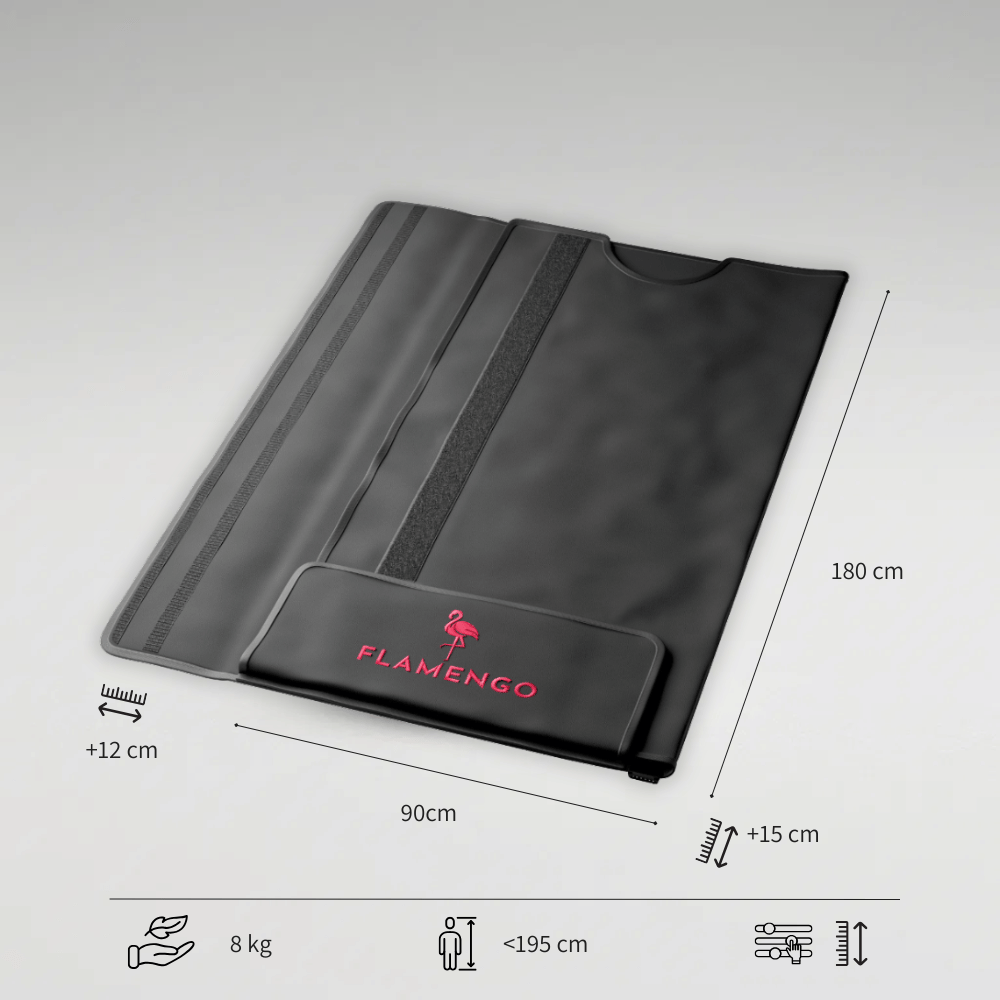
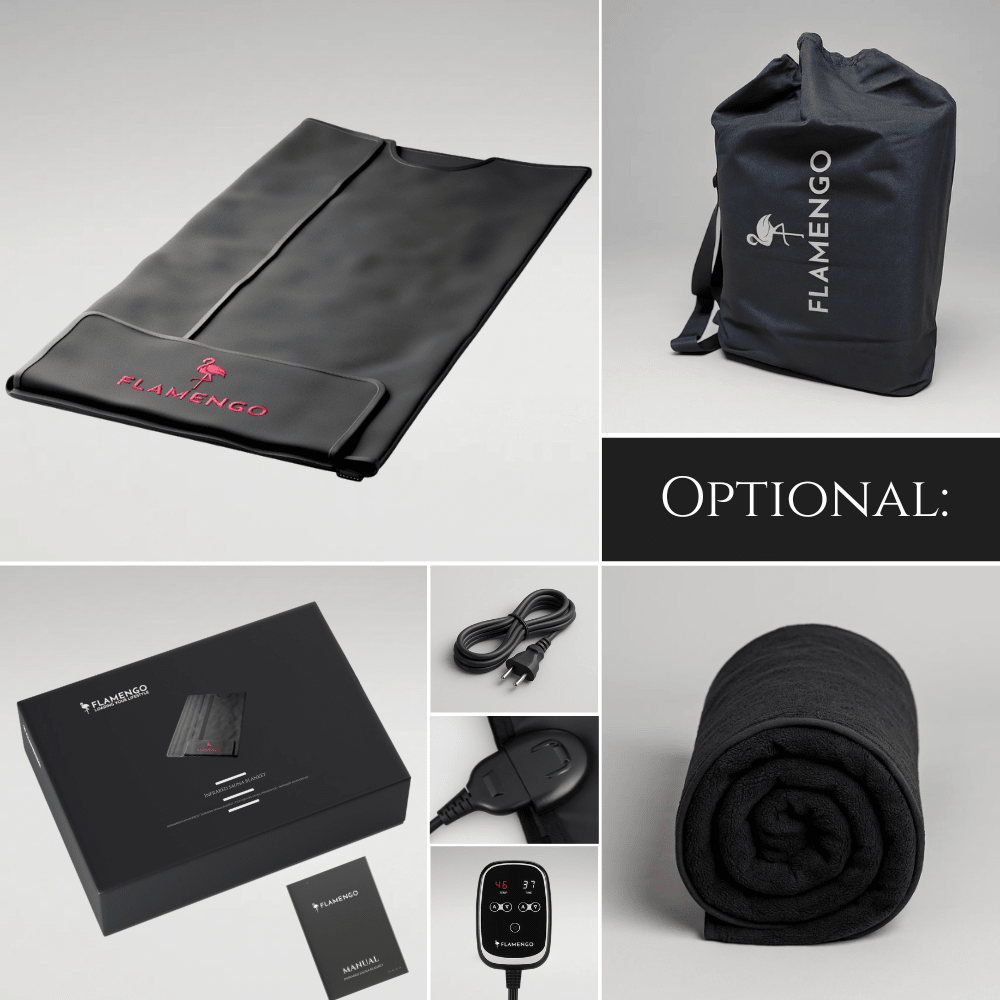
The Flamengo sauna blanket for stiff muscles — proven support
Of all the approaches we at Flamengo see working for stiff muscles — and we have helped thousands of customers with it — regular use of the Flamengo infrared sauna blanket is one of the most consistently positive. Whether it is stiffness from ageing, menopausal symptoms, office work or general tension: the combination of deep heat, circulation and relaxation works on several causes at once.

Three mechanisms by which the sauna blanket loosens stiff muscles — they work together, not separately.
Why does the Flamengo sauna blanket work so well for stiff muscles?
The infrared sauna blanket emits mainly far infrared (FIR), with a small measured share of mid infrared (MIR) that may contribute to a fuller heat experience. The radiation warms the skin; that warmth then spreads deeper into the tissue through conduction and greatly improved circulation — right into the muscle fibres and fascia. Want to know more about the technology and the measured wavelength spectrum? Read our complete guide. Three mechanisms work together:
- Deep heat relaxes muscle fibres: the warmed skin passes heat to deeper tissue, resulting in lower muscle tone — comparable to what a physiotherapist achieves with intensive massage, but passively;
- Improved circulation: blood vessels dilate, waste products are removed faster and nutrients are supplied faster. Essential for stiff muscles — poor blood circulation is a major cause of stiffness;
- Fascia become more supple: connective tissue responds to heat with reduced viscosity — literally "more fluid" — so that the ability of muscle layers to glide over each other returns;
- Lower cortisol: 30-45 minutes in a sauna blanket activates the parasympathetic nervous system. Lower cortisol means lower baseline muscle tension;
- Deeper sleep: a session 1.5-2 hours before bedtime improves sleep quality — and good sleep is crucial for muscle relaxation.
How do you use the sauna blanket for stiff muscles?
- Frequency: 3 to 4 sessions a week is optimal. Daily use is fine, but consistency matters more than daily intensity;
- Temperature: start at 50-55°C for the first 1-2 weeks, then gradually build up to 55-65°C;
- Session length: 30 to 45 minutes. Beginners start with 20-25 minutes and build up;
- Best time: in the evening, 1.5-2 hours before bedtime — double benefit: muscle relaxation plus better sleep;
- After the session: 5-10 minutes of gentle stretching — your muscles are now warm and supple, the ideal moment to build flexibility;
- Hydration: 250-500 ml of water before and after each session.
- Stiffness that lasts longer than 6-8 weeks or increases noticeably fast — see your GP;
- Do not use with fever, acute infections or in the first 6 weeks after surgery;
- During pregnancy, consult your midwife first;
- Drink enough water before and after each session;
- If in doubt about suitability: consult your GP or physiotherapist.
Frequently asked questions about stiff muscles
At night your body moves little: joint fluid circulates less, body temperature drops and circulation slows. For most people this passes within 10-15 minutes of getting up. Does it last longer than 30 minutes? Then it may point to osteoarthritis, or with longer stiffness (>1 hour) to rheumatism. For persistent morning stiffness, heat therapy the evening before helps noticeably.
A combination works best: heat therapy for direct relief (infrared sauna blanket 3-4x/week), daily exercise (at least 30 min), enough water and magnesium, stress management and good-quality sleep. No single approach works as well as this combination. During menopause or with vitamin D deficiency: also consider hormonal treatment or supplements.
Age is a factor — less collagen, slower circulation, sarcopenia. But age is not unchangeable: strength training, nutrition, exercise and heat therapy can significantly reduce most age-related stiffness. "Getting older = getting stiffer" is largely a lifestyle choice.
Yes, many women experience structural stiffness for the first time around 45-55. Falling oestrogen affects connective tissue, pain perception and sleep quality — all three contribute to stiffness. Heat therapy, strength training, protein and good sleep help significantly. With severe symptoms: discuss hormone therapy with your GP.
Mainly vitamin D and magnesium. Vitamin D deficiency is common in the Netherlands, especially in winter — it causes muscle stiffness and weakness. Magnesium is crucial for muscle relaxation; a deficiency causes cramps and stiffness. Omega-3 (fish oil) also has an anti-inflammatory effect. Get a blood test at your GP before you start supplementing.
Yes, and it is one of the most direct solutions. The combination of FIR and MIR warms the skin; via the circulation that warmth reaches deeper into the muscle fibres, relaxes them and helps the fascia become supple again. Many customers notice a clear improvement after 3-4 weeks of regular use (3-4x/week, 30-45 min) — less morning stiffness and overall relaxation.
Yes, and it is recommended. Inactivity makes stiffness worse. A warm-up is important though: 5-10 minutes of cardio followed by dynamic stretching before you go all out. Cooling down with static stretching after training also helps. With severe stiffness, start at low intensity: walking, swimming, yoga.
For some people, yes. Refined sugar causes subtle systemic inflammation that sensitive people can feel as stiffness and joint complaints. Try 2-3 weeks of less sugar and processed food to see whether it makes a difference. Not everyone responds the same way — it's a personal factor.
Conclusion
Stiff muscles are not an inevitable part of getting older or a busy lifestyle. With the right combination of heat therapy, daily exercise, hydration, magnesium, stress management and good sleep, you can make your muscles supple and loose again — at any age. Of all the approaches, regular heat therapy with a Flamengo infrared sauna blanket works most directly and consistently for many people — the combination of deep heat, circulation and muscle relaxation tackles several causes at once. Expect a noticeable difference within 3-4 weeks of regular use: less morning stiffness, easier movement and overall relaxation. If stiffness lasts longer than 6-8 weeks or comes with pain: always contact your GP to rule out underlying causes.
Get your muscles supple again with deep heat that makes a noticeable difference within 3-4 weeks.
View the infrared sauna blanket →This article is for information only and does not replace medical advice. If symptoms persist, always contact your GP. Flamengo supplies wellness products for self-managing symptoms — not medical devices.