

Ice bath in the garden: how to set one up

Ice bath in the garden: how to set one up
Cold water in your own garden is closer than most people think. No renovation, no connection, no permit – a level spot, a garden hose and an afternoon. In this article: where you can put the bath, how to set it up and how to use it all year round.
An ice bath in the garden takes less than most people think: no renovation, no installer, no fixed connection. A cold plunge needs nothing more than a level spot and a garden hose. You can set it up in an afternoon and use it that same evening. In this article we go through the practical side: which spots work, how the set-up goes, how to keep the water cold and clear, and why winter is actually the easiest season.
Why the garden is the best spot
You can put an ice bath indoors, but outside is simply more pleasant – and more practical. No condensation in the house, no worries about the floor and no room you lose permanently. And most importantly: stepping into cold water outdoors feels different. Fresh air, daylight, the sounds of your own garden. Many people find that the session feels shorter than it is as a result.
On top of that, the garden gives you more freedom in size. Indoors you often choose the smallest bath that fits; outdoors you can go for a roomy bath in which your shoulders really go under – and that does make a difference to the effect.
Set up in six steps
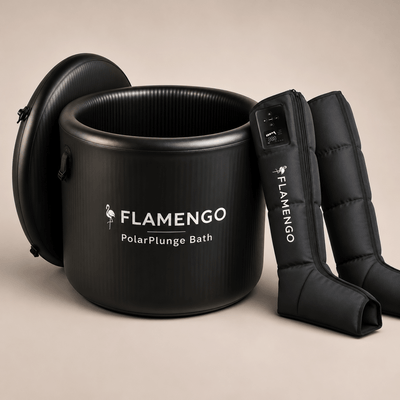
You can set up an inflatable drop-stitch bath yourself, without tools and without help. Roll it out, inflate it with the included pump to the indicated pressure, and fill it with the garden hose. That's all there is to it.

From box to cold water – without an installer, connection or renovation.
Filling takes the longest: 450 litres run in from a normal garden hose in about half an hour. In the meantime you can get the lid ready and decide where the cooling unit will go if you add one.
Where can the bath go?
On almost any level spot in the garden. The only real requirement is that the surface is level and firm – not that it is paved.

Tiles, grass or decking: almost any level spot in the garden works.
Tiles and patio
The easiest choice. It is already level, it won't sink and you can walk to it with dry feet. Place a spirit level on it before filling; a difference of a few centimetres shows at the waterline.
Lawn and gravel
This works well and in practice is the most popular spot. An inflatable bath has a flat base, so the weight is spread over the whole footprint instead of standing on feet. Choose a patch of grass that feels level and firm. A protective mat, a piece of pond liner or a few decking tiles underneath keep the base clean and spare your lawn.
Wooden decking or roof terrace
That works too. If the floor feels firm and level when you walk on it firmly, you're fine. If you notice that old decking clearly gives or boards bend, choose a spot on the ground instead – also simply because a springy surface is less comfortable to sit on.
The advantage of a movable bath
This is where an inflatable bath really beats a fixed tub, and it is rarely mentioned. You change the water periodically anyway. At that moment the bath is empty – and an empty drop-stitch bath weighs around fifteen kilos. You can lift it with two hands.

Every time you change the water, you can choose again where the bath goes.
That means your spot is never fixed. In summer on the patio where the sun doesn't reach, in autumn closer to the back door. Having a party or redoing the garden? Just move it aside. Moving house? The bath goes with you in the car.
With a fixed tub, that first choice is for good. It stays where it is, is too heavy to lift even when empty, and is often tied to pipework. If after a season another corner of the garden turns out to work better, you're out of luck.
Cooling in the garden: sun, lid and ice
Outdoors you have something that's missing indoors: the weather often works in your favour. From October to April, tap water in the Netherlands is already fairly cold, and outside it drops further on its own.
In summer two things help. First, the spot: a bath in full midday sun warms up, while the north or east side of the garden or a spot under a tree makes a noticeable difference. Second, the lid. A closed bath holds on to its cold and stays clean; left open in the sun, you lose the effect within half a day.
Ice or a cooling unit?
For occasional use, ice is enough. If you want to use it regularly, that quickly becomes unworkable: to get 450 litres properly cold you're talking tens of kilos per session. A cooling unit keeps the water at temperature automatically, down to around three degrees, so the bath is always ready. All you need is an earthed outdoor socket. More on that trade-off in our article buying an ice bath: what to look out for.
Filling, changing the water and keeping it clean
You fill it with the garden hose. Emptying is just as simple: put the hose in the bath, let it fill up and siphon the water to a lower point in the garden. Even faster with a submersible pump costing a few tens of euros.
Where the water can go: spreading it over the garden is fine as long as you work without chemicals. If you use a disinfectant, let it drain into the sewer or a street drain rather than onto the same flower bed every time.
How often should you change the water?
With filtration and disinfection you usually only need to change the water completely every one to two months. Without a filter it's more often – and that is exactly why a cooling unit with a built-in filter makes such a difference: cooling and filtering in one device.
Two habits keep the water clear for a long time: a quick rinse in the shower before you get in, and putting the lid on as soon as you're out. Together they do more than any product.
The garden in winter
Winter is the easiest season for cold therapy, not the hardest. The water is cold on its own, your cooling unit barely needs to run and your electricity use drops to almost nothing. Precisely in the season when many people think they have to stop, it actually becomes cheaper.
What to watch out for: keep the lid on so the surface doesn't freeze over, and make sure your path doesn't get slippery – a mat or anti-slip strip on the tiles is quickly laid. Want to take a break for a while? Empty the bath, drain the hoses and filter, and store it dry until spring. A fixed tub can't do that.
- Consult your doctor first if you have a heart condition, high blood pressure, Raynaud's phenomenon or epilepsy;
- If you are pregnant, consult your midwife or GP first;
- Build up gradually: start at around 12 to 15 degrees with short sessions of 30 to 60 seconds;
- Get out if you experience severe shivering, dizziness or numbness;
- Keep the lid closed when you're not around, especially with young children in the garden.
Frequently asked questions about an ice bath in the garden
Not for a movable bath: it is not a structure, any more than garden furniture or an above-ground pool. A sunken or bricked-in plunge pool may be a different matter. If you rent or live in an apartment, it's wise to check your tenancy agreement or the owners' association rules.
Yes, and that is the most popular spot in the garden. An inflatable bath has a flat base, so the weight is spread over the whole footprint. Choose a patch of grass that feels level and firm. A protective mat or pond liner underneath keeps the base clean and spares your lawn.
With an inflatable bath, yes. Empty, it weighs around fifteen kilos, and because you empty it periodically to change the water anyway, that automatically becomes the moment to move it. A fixed tub stays where it is: even empty, it is too heavy to move without help.
Only if you use a cooling unit. The bath itself works without power: fill it with the garden hose and pressurise it with the included pump. For a cooling unit, an earthed outdoor socket within reach of the bath is enough.
If you work without chemicals, you can simply spread it over the garden. If you use a disinfectant, let it drain into the sewer or a street drain. Siphoning with the garden hose works fine; a submersible pump makes it a lot quicker.
In summer it makes a considerable difference. In full midday sun, ice melts faster and a cooling unit runs longer. The north or east side of the garden or a spot under a tree works better. Putting the lid on as soon as you're out does at least as much.
Yes, and winter is actually the easiest season: the water is cold on its own and your cooling unit barely needs to run. Keep the lid on so the surface doesn't freeze over. If you take a break, empty the bath, drain the hoses and filter, and store it dry.
Rolling out and inflating takes a few minutes, filling with a garden hose about half an hour for 450 litres. You don't need tools, a connection or a second person. In practice you'll be in the water that same evening.
Conclusion
An ice bath in the garden takes surprisingly little: a level spot, a garden hose and a lid. Tiles, lawn or decking all work, and because an inflatable bath weighs only around fifteen kilos when empty, your choice is never fixed – every time you change the water, you can put it somewhere else. Place the bath where you'll still walk to it in November, keep the lid on and let winter do its work. Then cold water isn't a project, just something that stands in your garden.
8.5 cm insulated wall, 450 litres, suitable for people up to 2 metres – and only 15 kilos when empty, so you can put it wherever you like.
View the PolarPlunge ice bath →This article is for information only and does not replace medical advice. If in doubt about suitability, always contact your GP. Flamengo supplies wellness products for self-management – not medical devices.