Infrared sauna power consumption — what does a session really cost?

Infrared sauna power consumption — what does a session really cost?
An infrared sauna at home sounds like a luxury — but what does it actually cost per session, month and year? In this article we work it out for you in concrete terms, with figures per type. And we give five tips to save money.
With current energy prices, every kilowatt of consumption is a conscious choice. An infrared sauna can look like a big energy user, but the reality is often better than expected — especially with a sauna blanket. In this article we set out the consumption in concrete terms, compare the sauna blanket with a cabin and a traditional sauna, and give five practical tips to keep costs low.
How much electricity does an infrared sauna use?
Consumption depends on the type of sauna. An infrared sauna blanket is by far the most economical, a cabin sits in the middle, and a traditional sauna uses the most. This makes sense: a blanket heats only your body directly, while a cabin or traditional sauna first has to bring a whole room up to temperature.

Power consumption and annual costs of three sauna types at 3 sessions per week.
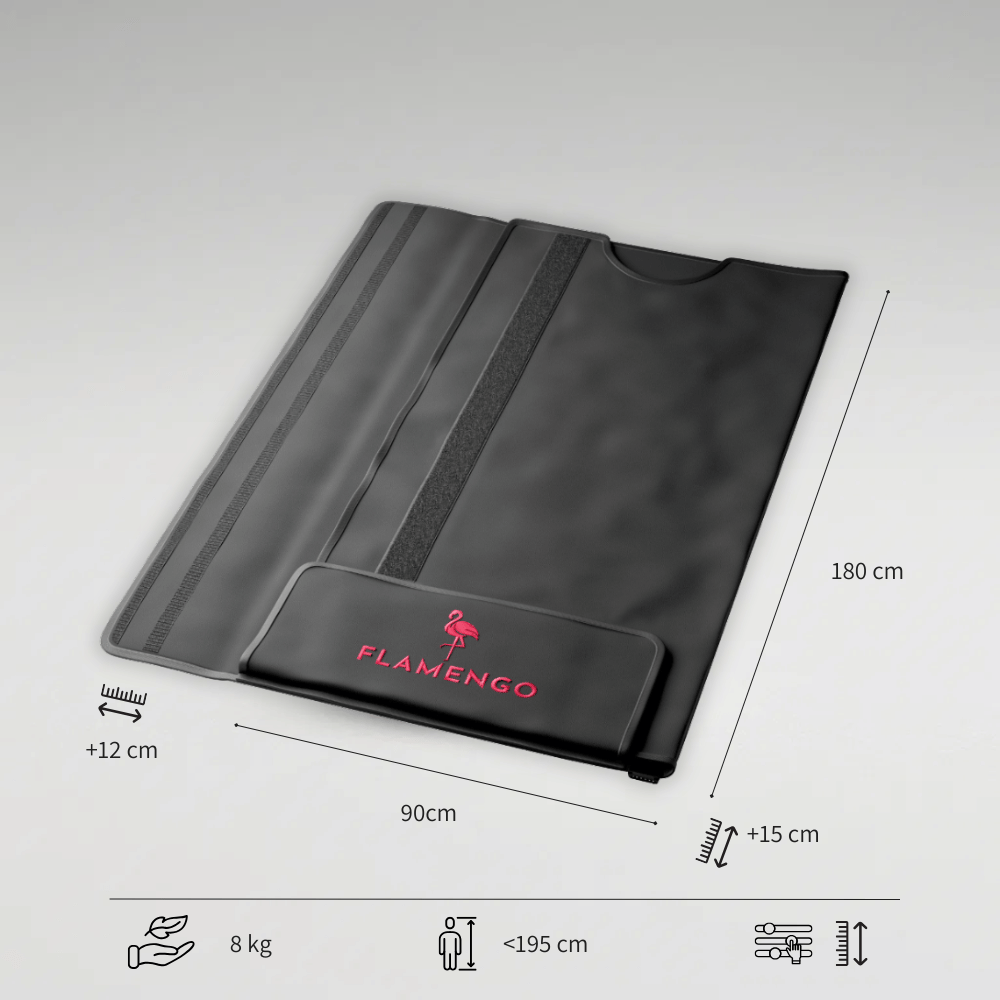
A Flamengo sauna blanket has a power rating of 650 watts. An infrared cabin for 1 to 2 people is between 1,500 and 3,000 watts. A traditional Finnish sauna uses 6,000 to 9,000 watts and also needs a long preheating time.
Sauna blanket electricity costs — calculated in concrete terms
The calculation is simple. We use an average electricity rate of €0.30 per kWh (kilowatt hour).
| Calculation | Sauna blanket (650 W) | Result |
|---|---|---|
| 1 session of 30 min | 0.650 kW × 0.5 hours = 0.325 kWh | €0.10 |
| 1 session of 45 min | 0.650 kW × 0.75 hours = 0.488 kWh | €0.15 |
| 1 session of 60 min | 0.650 kW × 1 hour = 0.65 kWh | €0.20 |
| Including warm-up (5 min) | + 0.054 kWh | + €0.02 |
The rule of thumb at Flamengo is €0.30 per average session (45 minutes including preheating) — a price comparable to a cup of coffee or a washing machine cycle at 40 degrees. That is a fraction of what a cabin or traditional sauna costs.
Annual costs — three scenarios
How much does a sauna blanket cost per year? That depends on how often you use it. Below are three typical usage scenarios.

Annual electricity costs of an infrared sauna blanket at different frequencies of use.
Even with intensive use, the annual electricity bill stays below €80. That is significantly less than what you pay for a wellness centre membership, a fitness app or an average coffee subscription. For anyone who takes their physical and mental well-being seriously, this is one of the most cost-efficient health expenses.
How does it compare to other appliances?
To put the consumption in context: how does a sauna blanket compare to other appliances you use every day?
| Appliance | Power | Cost per hour (€0.30/kWh) |
|---|---|---|
| Flamengo sauna blanket | 650 W | €0.20 |
| Hairdryer | 1,800 W | €0.54 |
| Microwave | 1,000 W | €0.30 |
| Washing machine (40 °C) | 900 W average | €0.27 |
| Vacuum cleaner | 700 W | €0.21 |
| Iron | 2,000 W | €0.60 |
| Infrared cabin | 1,500 - 3,000 W | €0.45 - 0.90 |
A sauna blanket uses about as much as a vacuum cleaner or a washing machine at 40 degrees. Cheaper than using your hairdryer every day.
Five ways to lower electricity costs
Although consumption is low, you can reduce it even further with these practical tips.

Five tips to lower the annual electricity costs of your infrared sauna blanket.
Not every energy supplier charges the same rate. A comparison site can save you tens of euros a year on your total electricity bill. With dynamic tariffs you sometimes pay 50 percent less per kWh during off-peak hours.
A session of 30 to 40 minutes gives just as much result as a 60-minute session. Research shows that the first 30 minutes deliver the greatest physiological effect. Consciously limit your sessions to save costs without giving up the benefits.
With dynamic tariffs or a day/night tariff, electricity is cheaper late in the evening and at weekends. Plan your sessions strategically — a late-evening session is relaxing and financially smart.
A sauna blanket only needs to be preheated for 5 to 10 minutes — not 20 or 30 minutes as with a large cabin. That makes a direct difference to your consumption. Read more about how an infrared sauna blanket works in our explanation of how it works.
Cheap sauna blankets often have poorer insulation and less efficient FIR elements. Result: they use more electricity for less heat. A quality blanket like the Flamengo, with an iso-cotton core and 36,000 carbon-fibre elements, delivers more infrared per watt.
Sauna blanket vs cabin — which is more economical?
For those weighing up a sauna blanket against an infrared cabin: the difference in cost is significant, not only at purchase but also in annual consumption.
| Cost aspect | Sauna blanket | Infrared cabin |
|---|---|---|
| Purchase price | €449 - 699 | €2,000 - 5,000+ |
| Power consumption | 650 W | 1,500 - 3,000 W |
| Electricity cost per session | €0.10 - 0.30 | €0.30 - 0.90 |
| Annual costs (3x week) | €47 | €47 - 140 |
| Installation | None | Fixed location needed |
| Maintenance | None | Periodic |
In terms of cost, a sauna blanket is the smarter choice for 90 percent of users. For those who like to sit upright or want a dedicated sauna room at home, a cabin may be worth the extra cost — but purely in terms of health effect it adds no extra value.
Frequently asked questions about power consumption
At 3 sessions per week and an electricity rate of €0.30 per kWh, a sauna blanket comes to about €4 per month. An infrared cabin is between €4 and €12 per month. A traditional sauna can run up to €30 per month.
A Flamengo sauna blanket has a power rating of 650 watts. In a 30-minute session it uses 0.325 kWh — which works out at about €0.10 at an electricity rate of €0.30 per kWh. An average session costs about €0.30 including preheating.
For a sauna blanket: about €0.10 to €0.30 per session depending on duration. For a cabin: €0.30 to €0.90. For a traditional Finnish sauna €2.40 to €3.60 including preheating.
Yes, considerably more economical. A sauna blanket uses 650 watts, a cabin 1,500 to 3,000 watts. In addition, a blanket heats only your body directly, while a cabin first has to heat a whole room. The difference in annual costs can run to €100 or more.
In a 30-minute session, a sauna blanket with a power rating of 650 watts uses 0.325 kWh. At 45 minutes 0.488 kWh, at 60 minutes 0.65 kWh. Including 5 minutes of preheating, add about 0.05 kWh.
Yes, a lower temperature means the heating elements switch on less often. A session at 55 degrees uses about 15 percent less than at 65 degrees. For beginners and people with chronic pain, 55-60 degrees often works perfectly well.
A sauna blanket uses less than half as much as a hairdryer (650 watts vs 1,800 watts). A 30-minute sauna blanket session costs €0.10, while using a hairdryer for 10 minutes costs about €0.09.
No. At 650 watts it simply works on a standard socket (16 amps). An infrared cabin with 3,000 watts sometimes needs a separate circuit or heavier connection — an important difference for anyone who wants to use a sauna without renovation work.
Conclusion
An infrared sauna uses less electricity than many people think — especially a sauna blanket. At about €0.30 per session and €47 per year with three sessions per week, it is one of the cheapest wellness investments you can make at home. Compared with a gym membership, a wellness visit or a good coffee machine, this is a fraction of the cost. For anyone who values health, recovery and relaxation, a sauna blanket is not only effective — it is also financially smart.
Sources: Milieu Centraal — Energy costs in the Netherlands, Consumentenbond — Electricity rates 2026. Calculations are indicative and based on average electricity rates.