

Ice bath benefits: 6 effects, with the downsides honestly included

Ice bath benefits: 6 effects, with the downsides honestly included
Cold water is credited with all sorts of things, from faster recovery to a better mood. Some of that is true and well supported. Some of it is experience, and sometimes exaggeration. Here is what an ice bath does for you — and what it doesn’t.
The benefits of an ice bath are more tangible than you might think. Less muscle soreness after a hard day, a head that feels clear for hours and a calm you rarely find anywhere else. Below are the six effects we hear about most often in practice, what happens in your body, and when you are better off skipping cold water for a while.
What cold water does to your body
When you step into cold water, a lot happens within a few seconds. Your breathing speeds up involuntarily, your heart rate shoots up and the blood vessels in your arms and legs constrict to keep heat in your core. That first reaction is called the cold shock response, and it is the same for everyone — even for people who have been doing this for years.

Four phases — and most of the pleasant part comes at the end.
What you can change with practice is how you respond to it. Calm, long exhalations damp the reflex within twenty to thirty seconds. That is the single most important skill you learn in an ice bath: your body is in top gear and you choose to stay calm.
At the same time, noradrenaline is released. That is the substance behind the alert, clear feeling people describe afterwards, and the effect lasts for hours. After the session, the blood vessels dilate again as you warm up, and that is where the wave of relaxation comes from.
Brown fat: your own heater
There is another mechanism that has received a lot of attention in recent years: brown adipose tissue. Unlike ordinary fat, brown fat does not store energy — it burns energy to produce heat. In the cold this tissue becomes active, and in people who regularly seek out the cold, the amount of active brown fat appears to increase. So during and after a cold session you measurably burn more.
To be honest about the scale: it is a modest amount of extra burning, not a substitute for exercise. But it is a real, measured effect, and it explains why you keep feeling so warm after warming up.
6 benefits of an ice bath
What is an ice bath good for? These are the effects that come up most consistently in research and in practice.

Six effects — some well supported, others mainly experience.
This is the best-supported effect. After intense or unusual exertion, muscles feel less stiff and tender in the days that follow when you go briefly cold. And that applies more widely than just sport: a day in the garden, a long walk, your first gym session in weeks, moving house. Wherever your body has done more than it is used to, you notice the difference the next morning.
The release of noradrenaline gives a sharp, awake feeling that lasts for hours. Many people therefore use the ice bath in the morning, as a replacement for or addition to their first coffee. This is subjective, but it is the effect people mention most often as their reason to keep going.
Because blood vessels constrict, cold can limit swelling after acute overload or a knock. That is exactly why cooling has been standard in sports care for decades. With a fresh injury, though: cooling relieves symptoms, it is not a treatment — persistent complaints should be looked at by a physiotherapist or GP.
This surprises most people the most. You expect tension, but what happens is that everything goes quiet. Once the first seconds have passed, for a moment there is nothing but this moment — no to-do list, no phone, no racing thoughts. For anyone with a busy mind that is a rare experience, and for many people it is exactly the reason to keep coming back. Afterwards, while warming up, a deep relaxation follows that lasts for hours.
Warming up is often followed by deep relaxation, and many people sleep better afterwards. Do mind the timing: too close to bedtime, the alerting effect can work against you. Those who use it for sleep usually plan it a few hours before going to bed.
The least measurable benefit, and for many people the most important. Every session is a small choice to seek out discomfort and carry on in control. Having done that first thing in the morning changes something about how the rest of your day feels. Hard to prove scientifically, but it is the reason people stick with it.
The downsides and risks
Searching for “ice bath downsides” often turns up little, because most articles are written by sellers. These are the points we think belong in the picture.
Mind the timing around strength training
Training specifically for muscle mass? Simply skip the ice bath on your strength training day. The inflammatory response that cold suppresses is partly the growth signal, and how long that signal continues is not precisely known. So keep it simple. For anyone not training specifically for muscle mass, this does not matter anyway.
Cold shock is a real risk
When you get in, you briefly lose control of your breathing. Going into the water alone is therefore not advisable while cold water still feels unfamiliar, and certainly not in the dark or outdoors without supervision. Build up in temperature and time rather than going all the way at once.
It is not medically sensible for everyone
Cold water puts strain on the heart and blood vessels. With a number of conditions, consulting your doctor beforehand really is necessary. See the box further down.
Ice bath before or after exercise?
After, not before. Cold muscles deliver less strength and speed, so just before exertion it is not a good idea. If you still want to go cold on a day you exercise, do it afterwards or well beforehand, with enough time to warm up again.

When cold water fits best.
After that it is simple: if you want to feel fresh again tomorrow, cold water comes into its own. After running or cycling, after a day in the garden, after a long day on your feet. Only those training specifically for muscle mass skip the bath on their strength training day.
And for most people this whole dilemma does not apply. If you use the bath in the morning or on a rest day, separate from your training, it is about alertness, relaxation and getting used to the cold — and the timing around exercise is not relevant.
How long and how cold?
Shorter and less cold than most people think. Two to five minutes is enough for most; beginners start with thirty to sixty seconds. Longer brings no extra benefit and only increases the risk of hypothermia.
As for temperature: start at around twelve to fifteen degrees and only go lower once your breathing stays calm. Most people end up between eight and twelve degrees. Below five degrees rarely adds anything. You can read more about this, including how to build up in steps with a chiller, in our article on the ice bath with chiller.
Two or three times a week is a fine rhythm for most people. Consistency does more than intensity: three short sessions every week work better than an occasional long one that you then put off for weeks.
Three persistent myths
| What you often read | How it really is |
|---|---|
| An ice bath makes you lose weight | There is a kernel of truth: cold activates brown fat, which burns energy to produce heat. But the scale is modest. See it as supportive within an active lifestyle, not as a weight-loss method in itself. |
| Colder is always better | Below five degrees the effect does not increase further, while the risk and the threshold do rise. At a temperature you cannot handle, your breathing tenses up and you will not keep it up. |
| An ice bath makes you immune to colds | Regular cold water seems to be associated with fewer sick days, but the evidence is limited and the effects are small. Do not expect protection from it. |
Who is it not suitable for?
Cold water is a strong stimulus for your heart and blood vessels. For most healthy people that is not a problem, but there are situations in which you should consult your doctor first.
- If you have a heart condition or arrhythmia;
- If you have high or poorly controlled blood pressure;
- If you have Raynaud’s phenomenon or other circulation problems;
- If you have epilepsy, because of the risk of a seizure in the water;
- During pregnancy: consult your midwife or GP;
- With a fever, an acute infection or shortly after surgery: skip it for now.
Beyond that, the same basic rules apply to everyone: do not go alone while cold water still feels unfamiliar, do not drink alcohol beforehand, build up gradually and get out if you shiver heavily, feel dizzy or go numb. Warm up actively with dry clothing and movement, not with a scalding hot shower.
Frequently asked questions about the benefits of an ice bath
For recovery after hard exertion, for an alert and clear head that lasts for hours, and for the calm that comes when your mind goes completely quiet for a moment. Many people also experience deeper relaxation and better sleep. See it as an addition to sleep, nutrition and exercise.
For most healthy people, brief cold water is safe and pleasant. With a heart condition, high blood pressure, Raynaud’s phenomenon, epilepsy or pregnancy, consulting your doctor is necessary. Always build up gradually in temperature and time rather than going all the way at once.
The cold shock response when getting in needs attention, so do not start alone while cold water still feels unfamiliar. If you train specifically for muscle mass, skip it on your strength training day. And with heart and vascular problems, epilepsy or pregnancy, consult your doctor first.
After exercise. Beforehand, cooling lowers your muscle temperature, so you deliver less strength and speed. Afterwards it is actually pleasant: after running, cycling or a long day on your feet, you wake up fresher the next morning. Only those training specifically for muscle mass skip it on their strength training day.
Two to five minutes is enough for most people. Beginners start with thirty to sixty seconds and build up over a number of weeks. Longer brings no extra benefit and increases the risk of hypothermia. Consistency does more than long sessions.
Cold activates brown adipose tissue, which burns energy to produce heat, and with regular cold exposure the amount of active brown fat appears to increase. So you measurably burn more. The scale is modest, though: see it as supportive within an active lifestyle, not as a weight-loss method in itself.
Two to three times a week is a comfortable rhythm for most people. Daily is possible too, provided you keep sessions short and warm up well. If you notice you are sleeping worse, staying cold for longer or finding it increasingly hard to start, cut back.
Not for healthy people, provided you build up gradually and do not start alone. The risks lie in the cold shock response when getting in, in staying in too long and in underlying heart or vascular problems. Drinking alcohol beforehand and starting very cold straight away are the two biggest mistakes.
Conclusion
Less muscle soreness after a hard day, a head that stays clear for hours and a quiet in your mind that you rarely find anywhere else — those are the effects that bring people back. On top of that, cold activates your brown fat and literally gets your body burning. Do not expect miracles: it is an addition to sleep, nutrition and exercise, not a substitute. Start at around twelve to fifteen degrees, keep it short and do it two or three times a week. Then it is not a feat, but simply something that is part of your week.
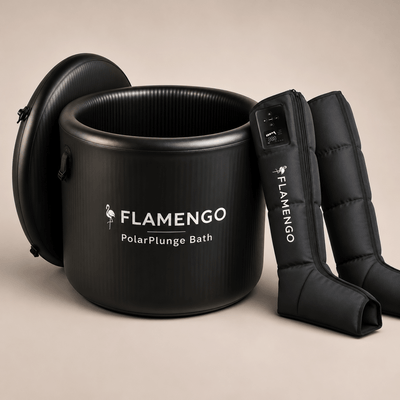
8.5 cm insulated wall and 450 litres — with the optional chiller you build up calmly in one-degree steps.
View the PolarPlunge ice bath →This article is for information only and does not replace medical advice. If in doubt about suitability, always contact your GP. Flamengo supplies wellness products for self-management – not medical devices.